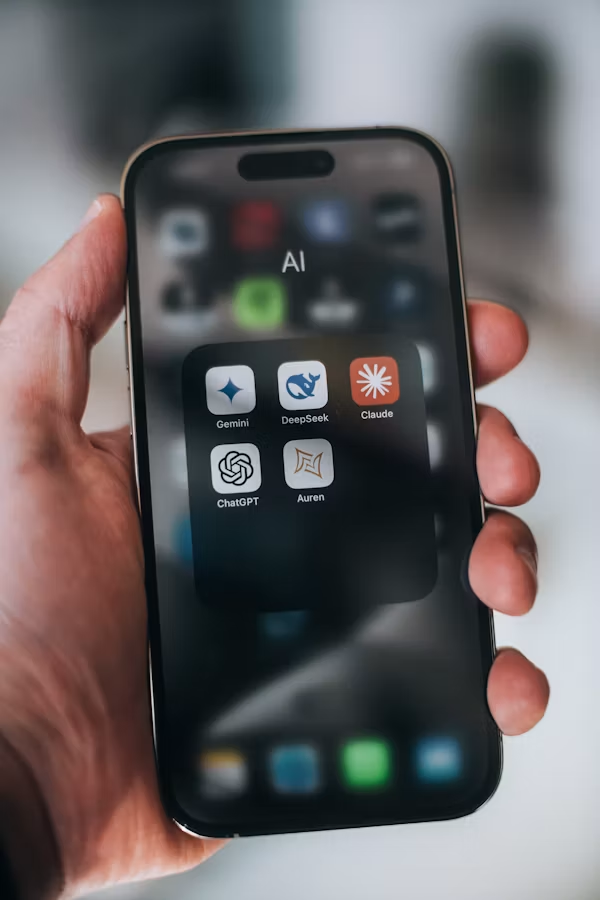
Is AI Actually Making Your Daily Life Easier? An Honest Look
AI is everywhere now writing emails, planning routes, recommending shows. But is it genuinely saving time and mental effort, or just adding a new layer of decisions to make? Here's an honest breakdown.
Madhusudan Burman
HR Executive at NoBroker
AI has quietly worked its way into almost every app we use daily autocomplete, recommendations, voice assistants, chat tools. The promise is always the same: less effort, more time saved. But does that hold up in practice, or does it just shift the effort somewhere else?
Where AI genuinely saves time
Repetitive, low-stakes tasks. Drafting a routine email, summarizing a long document, generating a quick recipe from what's in the fridge these are tasks where "good enough, instantly" beats "perfect, in 20 minutes." This is where AI's time savings are real and immediate.
Reducing decision fatigue on small choices. Letting an app recommend a route, a playlist, or a restaurant removes tiny decisions that add up over a day. The value isn't the recommendation being perfect it's not having to think about it at all.
Making information more accessible. Asking a direct question and getting a direct answer, instead of scanning five articles, genuinely saves time for simple factual queries something search engines were never quite built for.
Where it adds friction instead of removing it
When the output needs heavy editing anyway. If an AI-drafted email still needs significant rewriting to sound like you, the "time saved" is partially an illusion you've just moved from writing to editing, which isn't always faster.
When it creates a new decision: trust or verify? Every AI output comes with an implicit question is this accurate, or does it need checking? For anything important, that verification step eats into the time supposedly saved.
When it's used for things that don't actually need it. Asking AI to summarize a two-paragraph email, or generate a caption for a photo you could write in 10 seconds, adds a step rather than removing one.
The honest pattern
AI tends to save real time on tasks that are repetitive, low-stakes, or purely informational. It tends to add friction on tasks that are short, personal, or require real judgment. The mistake isn't using AI it's using it indiscriminately, for everything, without noticing which category a task actually falls into.
A simple test
Before reaching for an AI tool, ask: would doing this myself take longer than reviewing and fixing an AI's attempt at it? For quick, personal, or judgment-heavy tasks, the honest answer is often no.
FAQ
Does AI make people less capable of doing tasks themselves over time?
This is a genuine, actively debated concern particularly around writing and critical thinking skills with heavy reliance. Using AI as a starting point rather than a full replacement helps preserve those skills.
Is AI more useful for work tasks or personal tasks?
Generally more consistently useful for work tasks that are repetitive or information-heavy. Personal tasks are often quick enough, or personal enough, that AI adds a step rather than saving one.