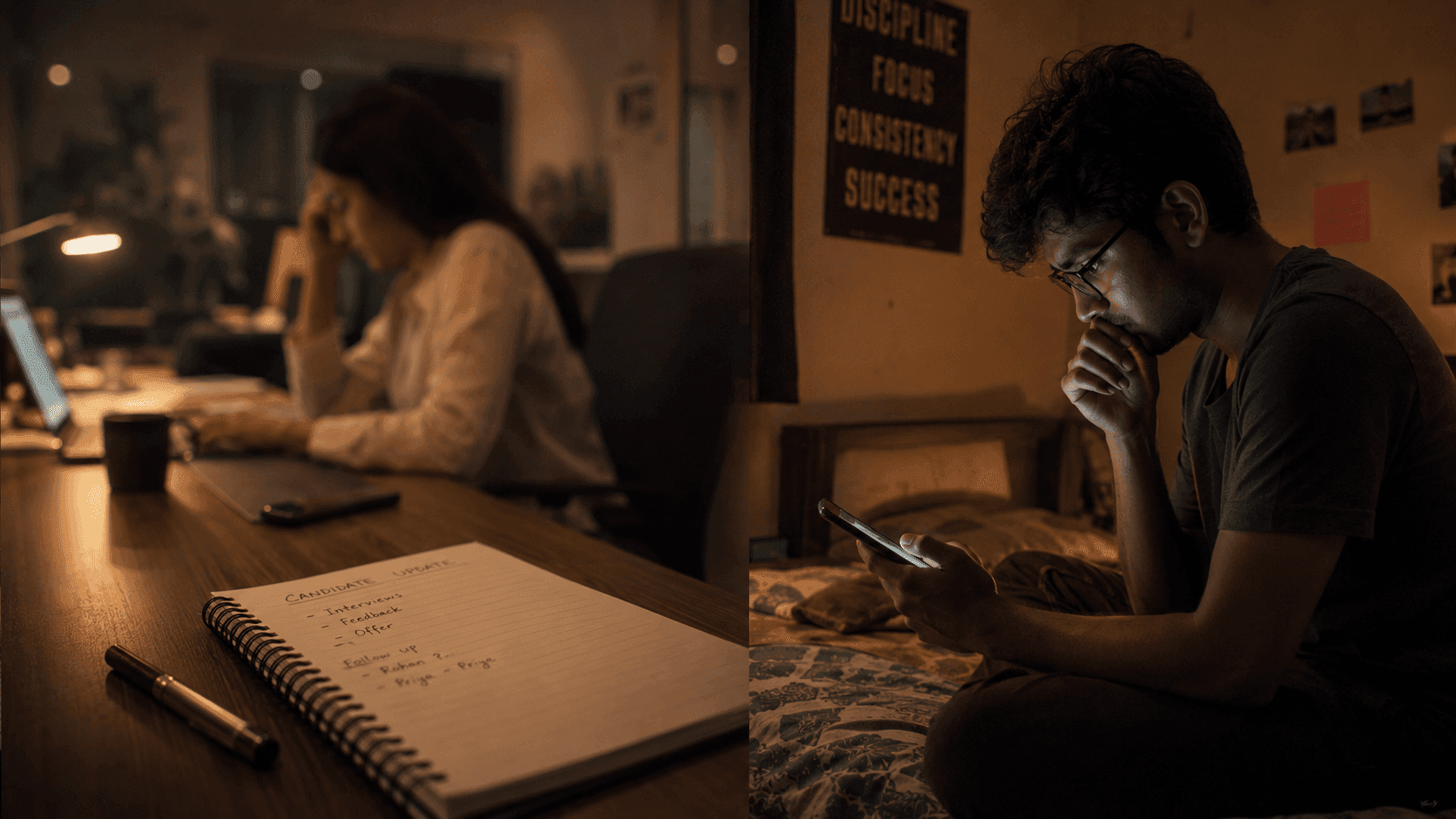
The Moment It Became About Both Sides
For a long time, I thought about this from one side, because that's the side I was standing on. What shifted it was a conversation, more than any single insight.
Madhusudan Burman
HR Executive at NoBroker
For a long time, I thought about this from one side, because that's the side I was standing on. I saw the recruiter's exhaustion, the fifty calls, the templates that started feeling less like communication and more like triage. It was easy to think the fix was about making that side lighter.
What shifted it was a conversation, more than any single insight sitting with someone who'd been job hunting for months, listening to them describe the specific ache of applying carefully and hearing nothing back, not even a no. I'd heard versions of this before, professionally, at a distance. Hearing it from someone I actually knew, without the professional distance in the way, landed differently.
I remember sitting with that conversation afterward, turning it over, and realizing something uncomfortable: I'd spent years thinking about how to make hiring less exhausting for the person doing the hiring, and comparatively little time thinking about what it actually felt like on the other side of that same exhaustion. Both people were tired by the same broken process. Neither side was the villain. I'd just been looking at one half of the picture and calling it the whole thing.
Once I saw it that way, I couldn't unsee it. Every design decision, every principle I'd been forming, suddenly needed to answer to two people instead of one and more than that, needed to check that helping one wasn't quietly costing the other. It's a harder standard to hold. A fix that only makes the recruiter's day easier isn't actually a fix, if it makes the candidate's experience worse in the process.
I don't think I fully understood, before that shift, how much easier it is to build for the side you know best. It takes real, deliberate effort to hold both sides in mind at once, especially when you only really have direct, daily experience of one of them.
I'm still learning how to do that well. But I know now that anything I build has to answer to both people in the exchange, not just the one whose exhaustion I understood first.